Your basket is currently empty!
Blog
-
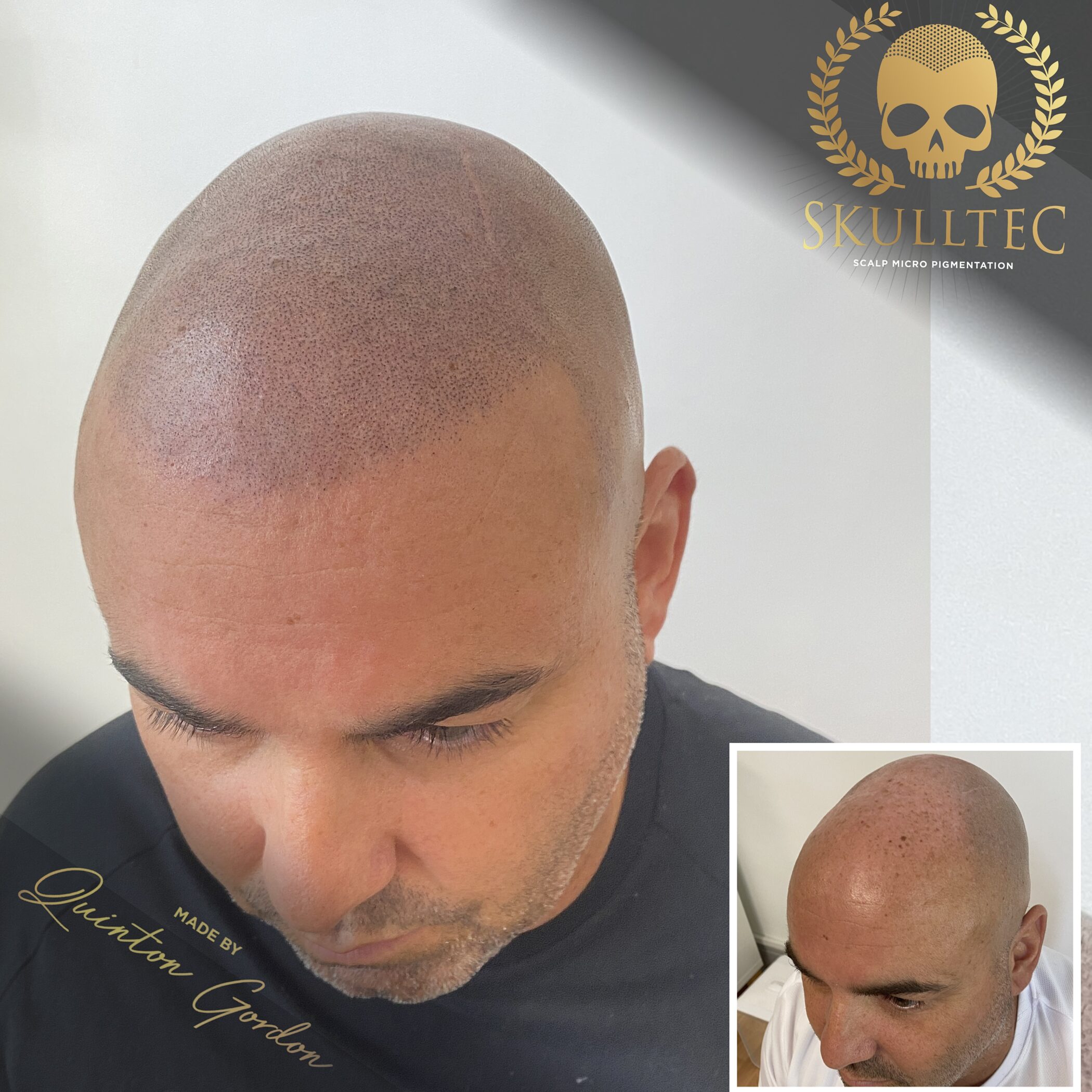
Scalp Micropigmentation Treatment Devon
Scalp Micropigmentation Devon
Replicating hair follicles with the use of cutting-edge micro-pigmentation procedures can provide rapid answers to hair loss.
The Art of Micropigmentation for Men
Micropigmentation of Women’s Skin
Digital Microblading (Eye Brows)
Instant Hair Loss Solutions
Men and women who are experiencing hair loss can turn to Skulltec-Southwest for immediate assistance in finding a solution to their condition. By employing the most recent scalp micro pigmentation technology, Skulltec-Southwest is able to reproduce the hair follicles, so making your hair appear thicker (if you already have hair) or providing the impression of hair to people who have shaven heads. We are also able to hide any scars or other imperfections on the head.
In addition, Skulltec-Southwest provides digital microblading services for brows and eyelashes. Your eyebrows can be reshaped, defined, and any gaps between them filled in by us to make them appear larger and more defined.
[button text=”Click for more info” expand=”true” link=”https://skulltec-southwest.co.uk/contact/”]
-
Scalp Micropigmentation Treatment Cornwall
Scalp Micropigmentation Cornwall
Replicating hair follicles with the use of cutting-edge micropigmentation procedures can provide rapid answers to hair loss.
The Art of Micropigmentation for Men
Micropigmentation of Women’s Skin
Digital Microblading (Eye Brows)
Instant Hair Loss Solutions
Men and women who are experiencing hair loss can turn to Skulltec-Southwest for immediate assistance in finding a solution to their condition. By employing the most recent scalp micropigmentation technology, Skulltec-Southwest is able to reproduce the hair follicles, so making your hair appear thicker (if you already have hair) or providing the impression of hair to people who have shaven heads. We are also able to hide any scars or other imperfections on the head.
In addition, Skulltec-Southwest provides digital microblading services for brows and eyelashes. Your eyebrows can be reshaped, defined, and any gaps between them filled in by us to make them appear larger and more defined.
[button text=”Click for more info” expand=”true” link=”https://skulltec-southwest.co.uk/contact/”]
-

Classifications of Patterned Hair Loss
[button text=”BOOK YOUR CONSULTATION NOW” expand=”true” link=”https://skulltec-southwest.co.uk/contact/devon/”]
Pattern hair loss, sometimes referred to as androgenetic alopecia, affects both men and women equally frequently. Because it manifests in distinct patterns, this type of alopecia is more commonly referred to as pattern hair loss. However, the patterns experienced by men and women differ.
male-pattern baldness
Male pattern hair loss will impact more than 50% of all men over 50, according to study. Genetics is the main factor causing pattern hair loss in men, and studies have linked it to androgens, the hormones produced during sex.
The Norwood Scale
The Norwood Scale, a seven-point scale that identifies the stages of male pattern hair loss, is used to quantify it. The higher the number on the scale, the more serious your hair loss is.
Norwood Type 1
Men with Norwood Type 1 have little to no hairline recession and no visible loss of hair at the crown. Some men frequently carry on a Norwood Type 1 hair pattern for the duration of their life.
Norwood Type 2
Men have little hair loss at the scalp’s top but a small recession of the hairline at the temples. The earliest indications of the typical M-, V-, or U-shaped hairline start to show at this point. When they reach this stage, not all men continue to lose hair as they age.
Norwood Type 3
Men who have this condition see considerable hair loss at the scalp’s frontal region and the temples. The M-, V-, or U-shaped hairline typically forms at this time. At this period, some men also notice hair loss at the crown or vertex.
Norwood Type 4
At this stage, the front of the scalp, the temples, and the crown all show signs of hair loss. Men frequently have a thin hairline separating the two areas of the head where hair loss has occurred.
Norwood Type 5
Men with Norwood Type 5 hair have noticeable, obvious thinning at the front of the head, the temples, and the crown. The thinning of the hairband that separates the forehead and the crown is apparent due to the more pronounced hair loss. At this point, the hair loss horseshoe pattern is more obvious.
Norwood Type 6
At this stage, the front of the scalp, the temples, and the crown all experience severe hair loss. The little band that did separate the forehead and crown is then united to the areas of hair loss by thinning or complete hair loss.
Norwood Type 7
Men with Norwood Type 7 hair have the most extreme cases of male pattern baldness. The horseshoe pattern is now all that is left of the hair on the front of the head, the temples, and the crown.
female-pattern baldness
Pattern hair loss in women is also rather frequent. Before the age of 65, less than half of women will noticeably lose hair; this usually happens after childbirth or menopause. Hormones are likely to blame for the hereditary nature of female pattern hair loss.
Ludwig Scale
The amount of female pattern hair loss is measured using the Ludwig Scale.
Ludwig Type 1
Mild and barely perceptible thinning that starts at the crown of the skull. Women can observe their portion, which will broaden somewhat, for the first indications of thinning.
Ludwig Type 2
Significantly more scalp is beginning to appear, with visible balding on the crown or top of the head. The hair begins to feel or appear thinner, and shedding increases. Your hair no longer holding its previous styles is another indicator of mild hair loss. Your hair most likely won’t look the way it used to and will be more difficult to style. This could be due to a lack of volume or a wider part.
Ludwig Type 3
The crown and top of the head have much less hair. It is the most severe kind of female pattern hair loss. The left hair is so thin that there is no longer a contrast between the hair and scalp, making the scalp quite evident. Unexpectedly, more women will experience hair thinning than total hair loss in terms of female hair loss.
[button text=”BOOK YOUR CONSULTATION NOW” expand=”true” link=”https://skulltec-southwest.co.uk/contact/devon/”]
-
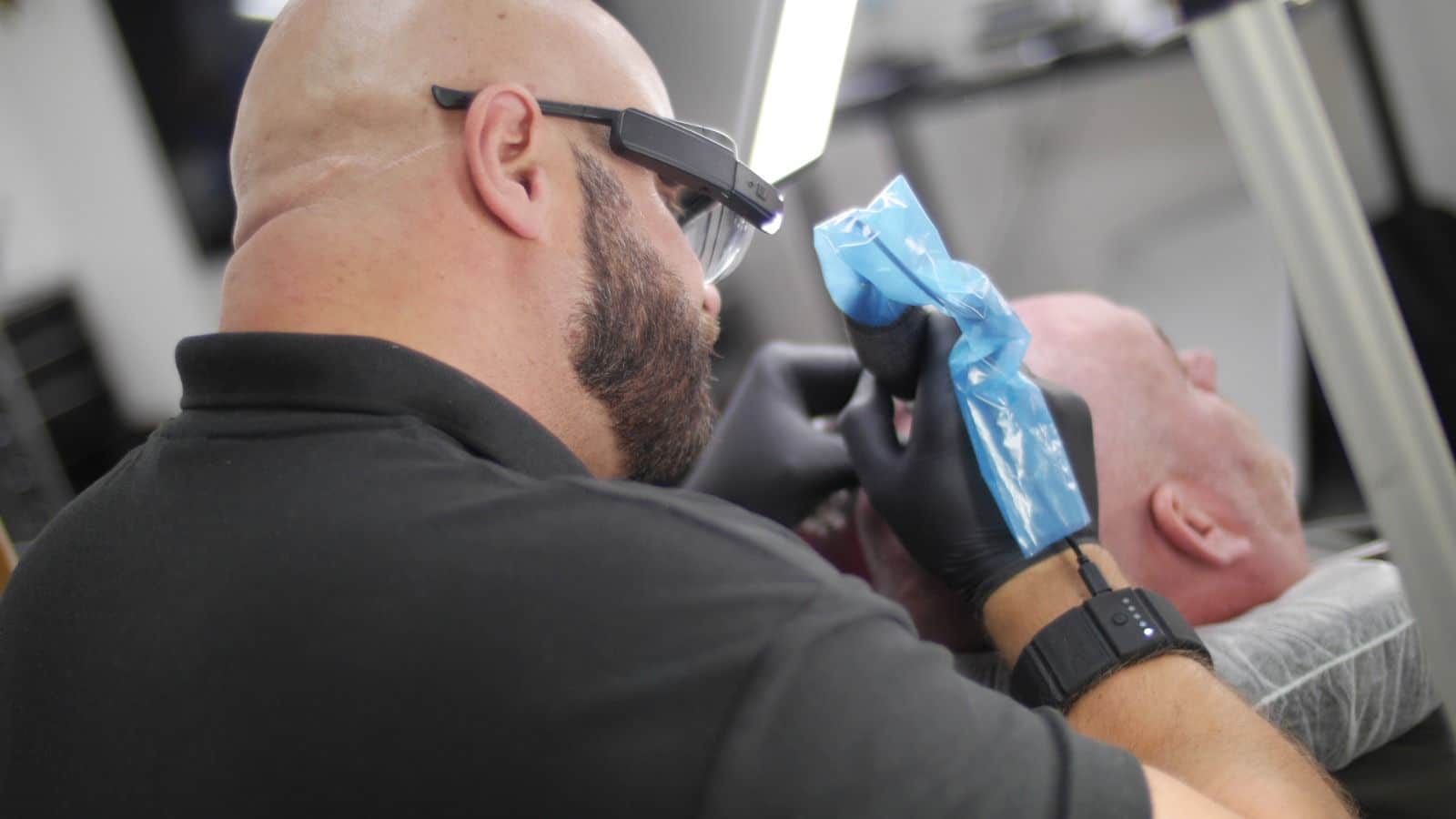
What is Scalp Micropigmentation?
[button text=”Click me to Book your Consultation” expand=”true” link=”https://skulltec-southwest.co.uk/contact/devon/”]
We can lose fifty to one hundred hairs per day; this is totally natural and of little worry, especially since it frequently occurs without our knowledge. Although hair loss is typically nothing to worry about, it occasionally can be an indication of a medical condition. While some types of hair loss are permanent, others might be temporary. If you experience sudden, obvious hair loss, bald patches, clumps of hair falling out, itchy or burning skin on your head, or if you are concerned about your hair loss, you should consult a doctor.
The various forms and reasons for hair loss include
Pattern baldness in both men and women
Alopecia
a condition Cancer treatment
Loss of weight
deficit in iron
hormone alterations (Pregnancy or menopause)
Permanent hair loss cannot be cured, however there are therapies you can attempt, such asshots of steroids
steroids creams
Immunotherapy
light therapies
Hair replacement
Surgery to trim the hair
transplants of synthetic hair.
These treatments are either surgically invasive and unlikely to be effective.Scalp micropigmentation is the top hair loss treatment in the globe. This is a non-surgical, non-invasive procedure where tiny dots are created in the scalp by properly qualified professionals at Skulltec Southwest. The tiny spots are filled with cosmetic pigment, giving the appearance of hair follicles. This is a fantastic hair loss remedy because it mimics a real shaved head appearance.
Scalp micropigmentation is best understood by comparing it to a scalp tattoo. A portable machine is used to repeatedly pierce the skin while implanting pigment, much like a tattoo. The primary distinctions between scalp micropigmentation and traditional tattooing are that the former does not penetrate the skin as deeply and the latter uses cosmetic pigment composed of natural materials instead of tattoo ink, which is more concentrated and has a heavier metal foundation.
Even though two to three sessions are recommended, the outcomes of scalp micropigmentation are assured, and you can experience improvements as soon as your first appointment. Unfortunately, scalp micropigmentation fades over time, thus it is recommended to receive touch-ups every three to four years.
The benefits of scalp micropigmentation include the restoration of the natural hairline, concealment of various types of alopecia and diffuse thinning, and an effective reduction in the visual impact of scarring, burns, or blemishes on the scalp. Scalp micropigmentation is also a safe procedure, and the pigments used during treatment are typically plant-based and full of natural ingredients. Finally, while this treatment does not promise to increase hair growth, it can nonetheless assert that it is sure to work because it covers up hair loss rather than treating it.
[button text=”Click me to Book your Consultation” expand=”true” link=”https://skulltec-southwest.co.uk/contact/devon/”]
-
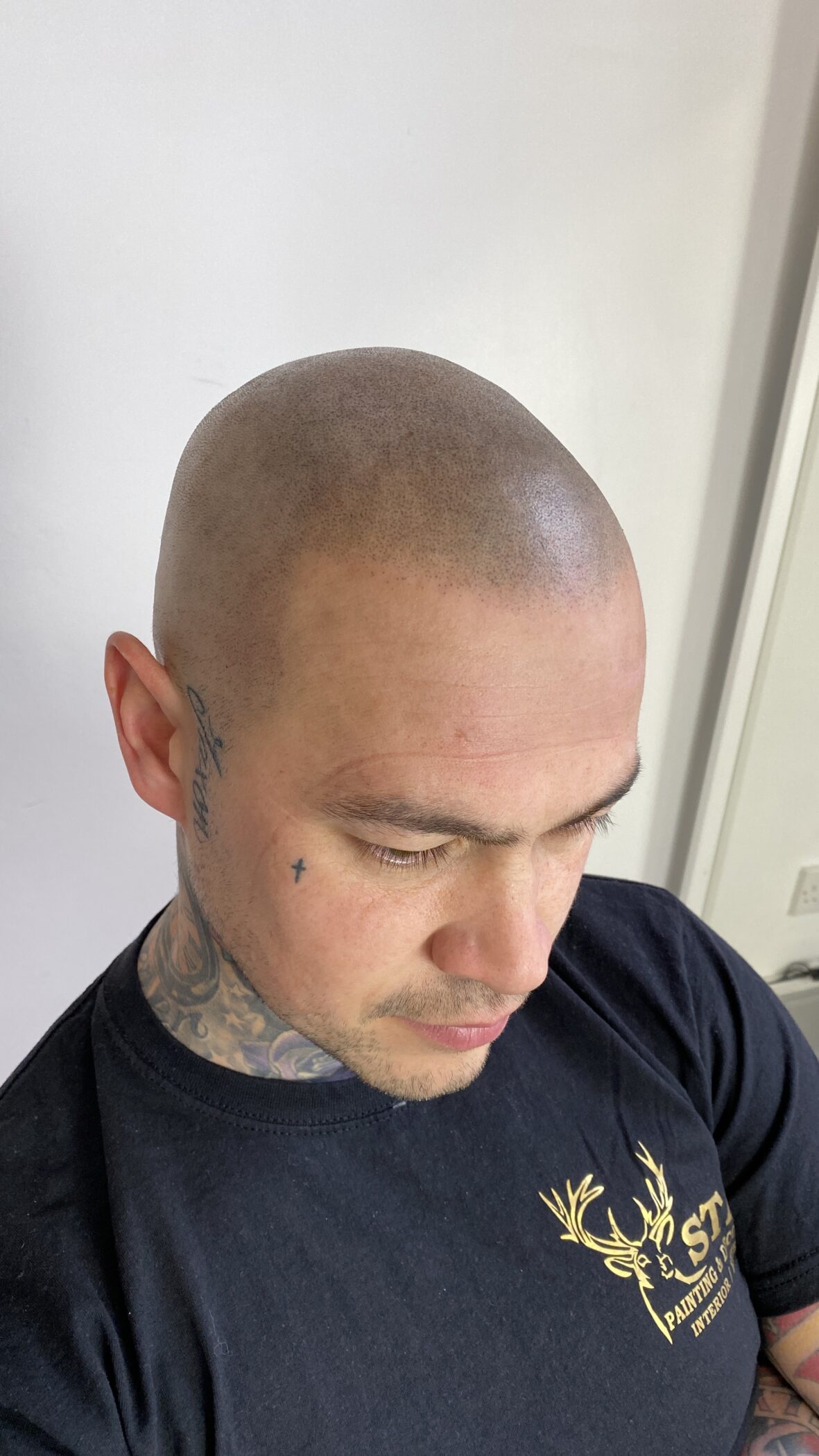
Scalp Micropigmentation Repair
[button text=”BOOK YOUR REPAIR NOW” expand=”true” link=”https://skulltec-southwest.co.uk/contact/devon/”]
Many people think that because scalp micropigmentation is technically a tattoo, any tattoo or permanent makeup artist can do it without any specialised training. The issue is that these novice businesses attempt to model their approach to scalp micropigmentation after a permanent cosmetics or tattooing process. They go out and buy tattoo ink or permanent cosmetics pigment and utilise the same procedure to apply it to their test subject. The main resemblance between scalp micropigmentation and tattooing is that both techniques insert pigment into the skin using a machine, but that is about where the similarities end.
The replication of hair follicles is a specialty of scalp micropigmentation artists. This is a very specialised field that requires a lot of patience and skill. Tattoo artists insert colour deep inside the dermal layer, whereas scalp micropigmentation practitioners insert colour just beneath the epidermal layer, in the papillary layer of the dermis. The tattoo’s replication of hair follicles seems more realistic because it doesn’t penetrate the skin as deeply. Another issue is dot size. Your head will wind up covered in enormous dots if the ink is applied too thoroughly, which is typical of all unskilled artists. Due to its proximity to the skin’s surface and the ongoing turnover of skin cells, the pigment used in scalp micropigmentation will eventually fade, but it will still endure for 3 to 5 years before needing to be touched up. Tattoo artists utilise a different type of pigment than those who perform scalp micropigmentation. Before being implanted into the skin, the pigment used in scalp micropigmentation is manufactured from natural components and is extensively diluted. In contrast to scalp micropigmentation, tattoo pigment is derived from metals like iron oxide and is deposited into the skin when it is very concentrated, which is why tattoos transform to a blue/green colour over time. Permanent makeup pigment and scalp micropigmentation pigment differ in that permanent makeup pigment is composed of a combination of numerous different colours to produce a hue, some of which are organic and some of which are not. Scalp micropigmentation pigment is black and carbon-based; it is lightened and diluted to better match natural hair follicles.
Scalp micropigmentation performed by untrained tattoo artists is almost certain to be what we refer to as a “botched work.” Because hair follicle replication is difficult because they are so small, a microneedle is employed. Tattoo artists frequently utilise the incorrect tools for scalp micropigmentation, which results in some really unattractive results.
How is the repair of scalp micropigmentation performed?
There are several ways to fix incorrect scalp micropigmentation.
Salabrasion
To erase tattoos, salabrasion employs salt imbedded in severely damaged skin. It is frequently performed by incorporating a saline solution with a high salt content using a tattoo gun’s multi-needle “shading” attachment. Then, until a scab forms and comes off, the wound must be kept absolutely dry. The tattooed region is now a little bit lighter since some of the ink from the tattoo is still in the scab. The end result is frequently a scar that is paler in colour than the original tattooed region. Given that this procedure may cause pain, an anaesthetic is occasionally provided.
Adding Color
When attempting to correct a subpar Scalp micropigmentation surgery, nearly all tattoo artists and permanent cosmetic artists have only one choice: adding more pigment. To try to correct it, they can only add additional pigment. Your experience with this kind of fix will simply make you more frustrated if your hairline is incorrect or the pigment is the incorrect colour. You must remove pigment and old scalp micropigmentation in order to effectively address the issue of poor scalp micropigmentation.
Laser Tattoo Elimination
The best solution for eliminating a subpar scalp micropigmentation job is to laser-remove the tattoo. Controlled removal and fading can be accomplished using medical-grade lasers, exact targeting methods, a choice of wavelengths, multiple spot sizes, and power levels. The entire scalp, smaller isolated patches, hairlines, and even single dots can be repaired in this method. This makes it possible to remove excess density, fade darker patches or sections, and straighten hairlines and side profiles.
Scalp micropigmentation results are only as good as the technicians doing the actual treatment. However, there is assistance available if you are among the unfortunate and require repair; Our clinic Skulltec Southwest carry out repairs to a high degree, leaving the distraught person content and full of confidence.
[button text=”BOOK YOUR REPAIR NOW” expand=”true” link=”https://skulltec-southwest.co.uk/contact/devon/”]
-
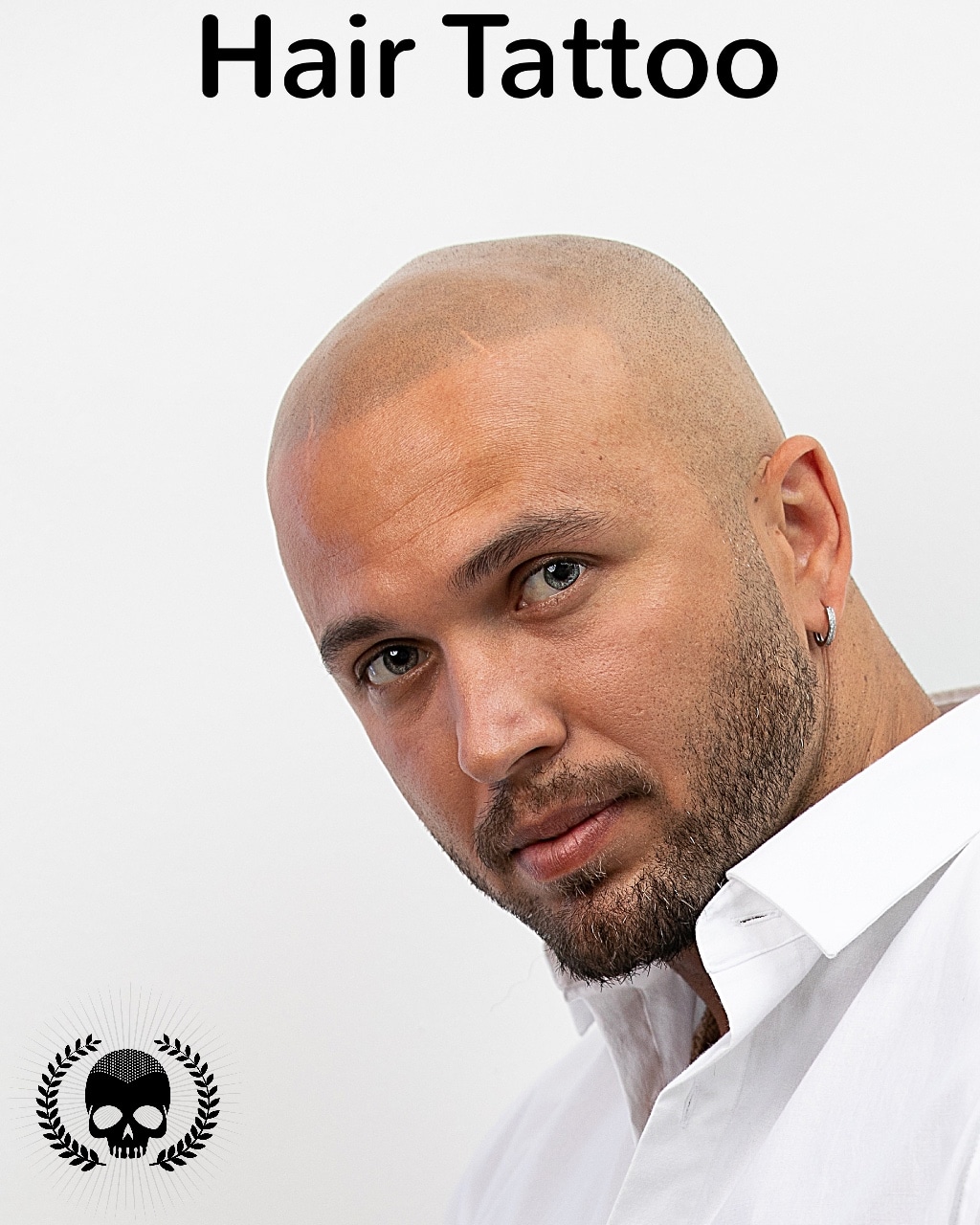
Scalp micropigmentation
SMP, also known as scalp micropigmentation, is a non-invasive, non-surgical procedure in which pigment is surgically inserted into the scalp to mimic hair follicles, giving the appearance of a full head of trimmed hair that perfectly complements your natural skin tone and hair colour. Although the two procedures are comparable, scalp micropigmentation is not the same as a scalp tattoo, despite popular belief. The type of ink used in tattooing and scalp micropigmentation is one of the key distinctions.
Although carbon is the major component, most inks used for scalp micropigmentation are created from natural materials. In contrast to tattoo ink, which has a metal basis and is composed of a range of colours to create the colour, including black, which is composed of bluey/green tones, the pigment is entirely black. Many people mistakenly believe that because the pigment in scalp micropigmentation is black and they have light-colored hair, they cannot get it done. This is not the case.
To make lighter-shaded pigment, any scalp micropigmentation pigment can be diluted. A dilution scale should be used to get the right measurements so that the dilution to pigment ratio is correct. Before implanting pigment into the skin, the following processes are taken:
To choose the right colour to fit the client and the right ratio, see the dilution chart.
Fill a treatment cup with the water content after measuring it. The amount of water in millimetres that is being measured must match the scale’s selected colour.
The pigment should be measured and added to the distilled water. No more than 1 millilitre of pigment should be used.
Last but not least, stir it.
If little to no water is applied, the pigment will be virtually entirely black; this is best for clients with dark complexion and hair because less water helps to preserve the colour of the pigment. Anyone with light complexion and blonde or light brown hair should use this pigment if a lot of water is added to it, preferably 20 millilitres and higher, give or take. Any clients with medium-toned complexion and medium-colored hair should drink the amounts of water in between.
In order to prevent the treatment from looking excessively dark after several sessions, the artist will typically use a light shade during the initial session. Depending on their preferences, the patient may elect to have the pigment slightly darker, although doing so will need them to wet shave frequently to prevent a colour contrast between their natural hair and their scalp micropigmentation treatment. Therefore, scalp micropigmentation can guarantee natural-looking results for those who are experiencing hair loss, regardless of the skin or hair colour. But keep in mind that there are clinics offering training in pigments, including Skulltec Southwest, here for your training needs.
[button text=”Click me! I want to learn more” expand=”true” link=”https://skulltec-southwest.co.uk/training/”]
-
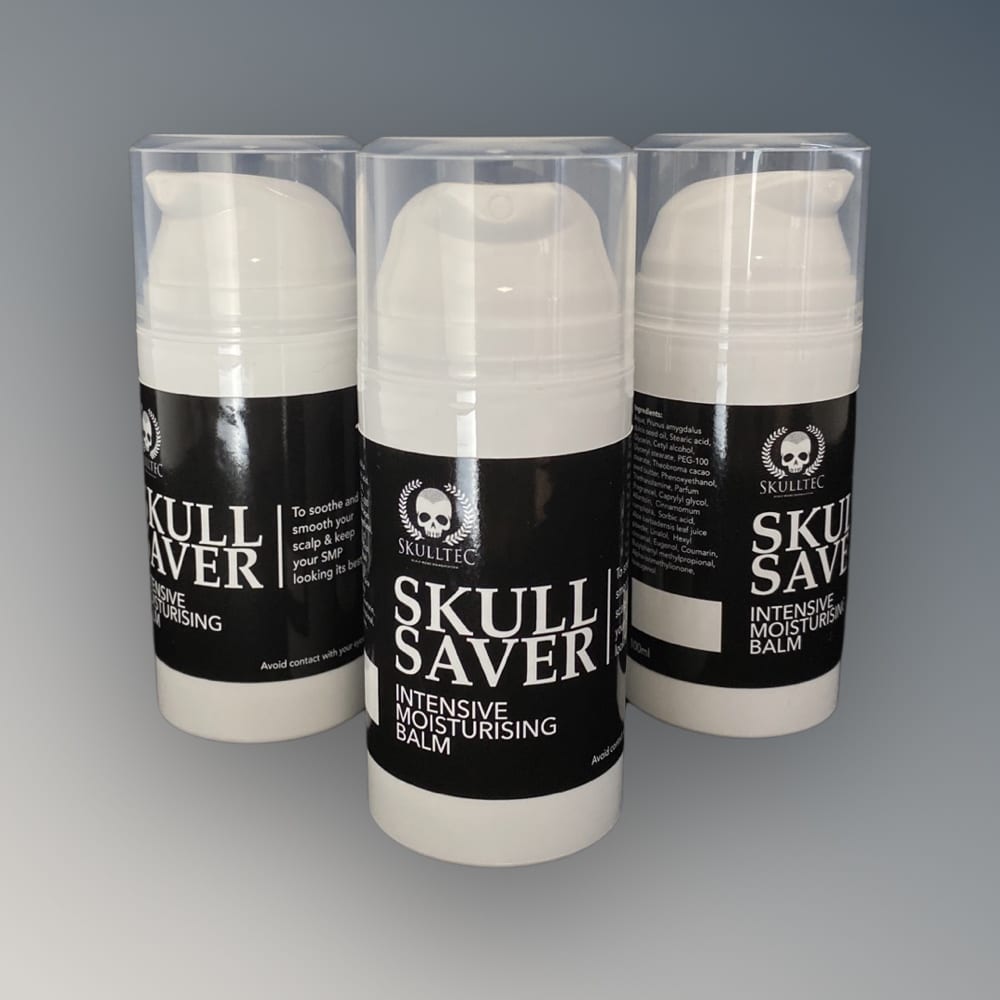
The Top Aftercare Advice For Scalp Micropigmentation
Before you can enjoy the results of your scalp pigmentation treatment, it is crucial that you follow the right aftercare instructions. Failure to do so may reduce the impact of your SMP treatment and potentially endanger your health.
[ux_image id=”844″]
[gap height=”60px”]
The procedure for getting a tattoo and scalp micropigmentation are very similar. In essence, you are having a tattoo on your scalp, but in this case, the goal and result are different.
Aftercare for scalp micropigmentation
After the procedure is over, fresh skin will develop over the top layer, which is what gives the result the most realistic appearance imaginable.After the procedure is through, life will pause for a short while by the side of the road before returning to its normal course. Over the next few days, you must avoid doing this.
- touching your scalp (unless in an emergency)
- wearing a hat, cap, helmet, or any other type of headgear that could cause your scalp to get irritated and rub
- letting any sunlight on your head
- excessive perspiration, especially after activity
- shampooing your head
- shaving the head
- Swimming
Your scalp will have started to mend and acclimate to its new pigmentation after this initial period of a few days. To ensure optimal aftercare for your scalp micropigmentation operation, there are still some procedures you must take. Following your treatment, over the following two weeks, you should:
- every day, merely use water to wash your scalp;
- Use an alcohol-free moisturiser on your scalp every day (Skulltec Product Recommended);
- Gently and carefully shave your head, taking care not to be harsh;
- When you swim, use a swimming cap;
- Try not to sweating too much.
- Avoid picking, scratching, or itching your scalp.
- Following a fortnight, you should: Daily wash and moisturise your scalp;
- Be careful when shaving your head; use sunscreen with a minimum SPF of 30 whenever you are in direct sunlight.The pigmentation of your treatment will appear darker right away as it is finished. One week following your last session, the actual and final colour will show. While the pigmentation may initially appear paler while the skin heals, you should under no circumstances pursue additional micropigmentation operations during the four weeks following the conclusion of your treatment.
from the tenth day onward.
The 10th day typically signifies that you have recovered enough to resume your regular routine, depending on how rapidly you recover from injuries. Your next appointment time will be set based on how quickly your healing has advanced thus far.Similar to the prior appointment, the practitioner will advise you to have a haircut and give your head a good wash, this time with shampoo or another product that is suitable for your skin. You should be aware that overexposure to the sun may cause your scalp to itch. Additionally, after the first session, the scalp tattoo will have slightly faded, so don’t be concerned by this. This is very standard fare.
[button text=”BUY OUR PRODUCT” radius=”10″ expand=”true” link=”https://skulltec-southwest.co.uk/shop/”]
[gap height=”60px”]
[button text=”Click here to book your consultation” radius=”10″ expand=”true” link=”https://skulltec-southwest.co.uk/contact/devon/”]
-
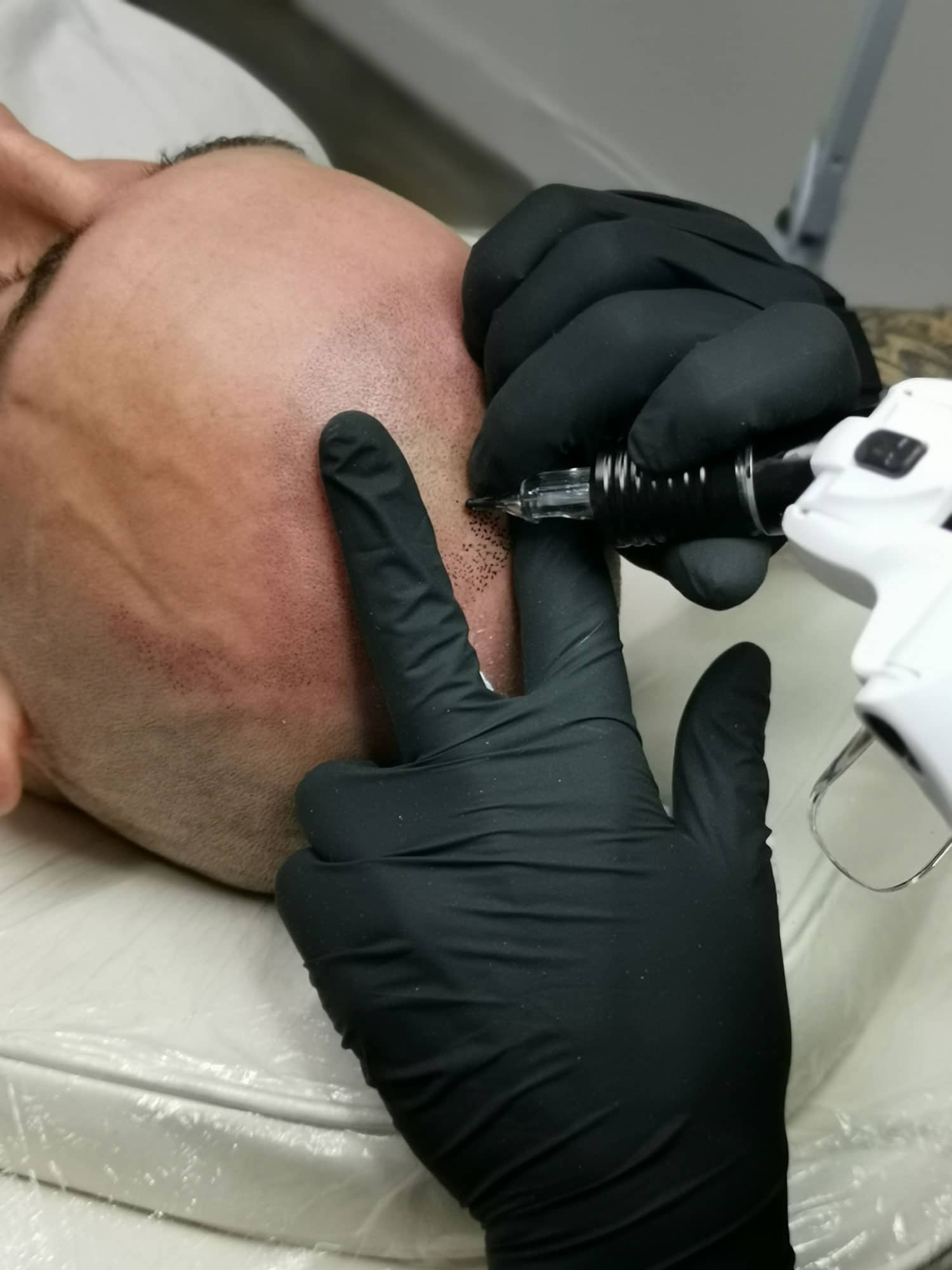
What is the recovery time for SMP?
Everything you need to know about the healing process for scalp micropigmentation.
A relatively recent procedure called scalp micropigmentation has been developed to cure alopecias and hair transplant abnormalities in men and women of all ethnic backgrounds. In contrast to hair transplantation, the treatment is non-surgical.
[ux_image id=”308″]
[divider width=”60px”]
SMP, hair pigmentation, and hair tattoo are some of the numerous terms for scalp micropigmentation. Despite what it is named, it is not a typical tattoo on the skin. Instead of employing the scraping technique (conventional tattooing), a qualified SMP Artist injects pigments using a dotting technique under the skin during the Scalp Micropigmentation procedure. The goal is to make all hair and scalp imperfections barely perceptible while creating the appearance of a scalp with higher hair volume.
The operation is harmless in and of itself, but because it punctures the skin, the immune system starts the healing process after scalp micropigmentation. It’s not as terrifying as it may sound.
How to execute scalp micropigmentation
An initial consultation occurs before the Scalp Micropigmentation Procedure. The customer and a scalp micropigmentation artist talk about reasonable expectations during this visit. Various cosmetic aspects, such as the existence of blemishes or scars on the scalp, skin colour, hair colour, and the quantity of hair present, influence the requirements, which change depending on these circumstances. Making a hairline and choosing the pigment colours are the first steps in the treatment. A certified SMP Technician puts a microdroplet of pigment through the epidermis and into the higher dermis during the initial scalp micropigmentation session. To reach the top dermis, the needle punctures the skin’s epidermal layer. Every scalp has a particular supporting structure and thickness. The SMP Artist’s training and experience determine the appropriate amount of pigment to apply. To get the desired result, it is important to modify the depth of needle entry because every scalp creates varied skin turgor.
Healing of scalp micropigmentation
The procedure for scalp micropigmentation is regarded as a damage to the skin, and understanding of the fundamentals Understanding the basics of the Scalp Micropigmentation Healing Process is essential.
Wound Meaning A wound is any place where the skin is disrupted. Disruption of typical anatomical structures and function is how it has been described.Healing Wounds Scalp Micropigmentation (SMP)
Results in a negligible tissue loss, and as a result, healing is categorised as Healing by Primary Intention. Our body immediately sets out to restore the integrity and barrier function of the skin. There are four stages to the healing process, and epidermal continuity is often restored within 24 to 48 hours. Within a month, the incision is covered by an intact epidermis and cellular connective tissue that is free of inflammation.
Process for Recovering Scalp Micropigmentation
The redness and potential swelling and tenderness of the skin emerge immediately after the pigment injection into the scalp. The body naturally starts the healing process for scalp micropigmentation. It’s natural for the skin to initially react to the therapy with redness. On lighter skin tones, it often goes away after about 24 to 48 hours. Darker skin tones are less prone to become quite red. From day 7 to day 13, the ink particles often gather in a more concentrated area in the upper dermis.
The skilled Scalp Micropigmentation Technician must balance what is visible at the surface during the initial session with the anticipated loss of some of the more superficial epidermal pigments within a few days. Scabs begin to form the first week after the redness goes away.
You must never attempt to scratch or remove the scabs on your own. These must naturally mend and shed their skin. There is a chance that the Scalp Micropigmentation would look uneven if you pierce the blisters. After about a week, the scabs start to come off, removing a considerable amount of pigment and producing a lightening effect. Smaller, lighter specks will continue to exist. The result obtained right after the initial SMP treatment session changes as the pigment settles and fades during the scalp micropigmentation healing process. Because some scabs heal more quickly than others, the results of scalp micropigmentation can appear uneven. There is no cause for concern.
The secret is to be patient. More ink will be injected into the scalp to improve density and create the appropriate hairline because the entire operation requires several sessions. Scalp Micropigmentation Healing Process varies from person to person because everyone is unique. Everything is dependent on the health, lifestyle, and scalp condition. It is crucial to speed up this process because the body must mend the skin on its own. The body will have an easier time healing the skin if it gets enough sleep since it will have more energy. In average, it shouldn’t take more than four weeks to see the final results of a Scalp Micropigmentation process.
[button text=”Click Here To Book a Consoltation” radius=”10″ expand=”true” link=”https://skulltec-southwest.co.uk/contact/devon/”]
-
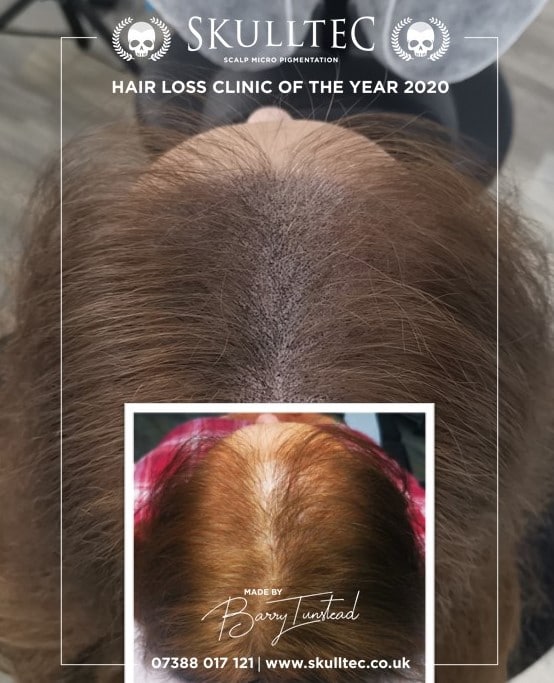
How Scalp Micropigmentation looks great on men of different ethnicities?
Everything you need to know about darker skin scalp micropigmentation.
Men of all ages are susceptible to the dermatological disorder known as alopecia (hair loss). Men lose hair and develop pattern baldness in a variety of ways and to varying degrees, regardless of their ethnicity. Sadly, that is the reality. Even while the hair loss issue is not life-threatening, its emotional toll always has an adverse effect on a person’s quality of life, adversely affecting the psychological well-being of affected males of all races. Why is obvious. The most noticeable aspect of the appearance is the hair. Therefore, those who experience hair loss must overcome its psychological effects and look for a workable cure. Thanks to Scalp Micropigmentation, hair loss conditions can now be successfully concealed.
[ux_image id=”853″]
Ethnic Hair Types
According to ethnic origins, researchers typically divide hair into three broad categories. Different hair characteristics are present in each ethnic group.
Chinese Hair Asian women typically have straight, black, and thick hair. This ethnic hair type has a variety of distinctive shapes and qualities. typically has the fastest growth rate (411+/-53 m/day) and the strongest mechanical characteristics.
African Hair African hair grows more slowly and is more brittle, which results in less stress during breakage and less fibre lengthening during breakage. is typically distinguished by tightly curled hair that grows nearly parallel to the scalp.
European Hair The appearance of Caucasian hair is straight, curly, or wavy. might range from blonde to dark brown in colour. has the most hydrated fibre and grows diagonally at a medium rate (367+/- 56 m/day).
Sadly, hair thinning and loss issues affect all of the aforementioned ethnic groups. Different ethnic groups experience hair loss in a variety of ways depending on the severity of the scalp’s decreasing coverage.
Dark skin, scalp micropigmentation
Everyone thinking about Scalp Micropigmentation anticipates non-artificial results that flawlessly complement their natural skin tone and hair colour. Anyone can undergo the operation, but the most important thing is how the treatment turns out in the end.
The process of scalp micropigmentation on a client with dark skin is difficult and increases the level of complexity of the treatment. It necessitates a thorough comprehension of the variations in hair morphologies, structures, and characteristics among different groups. A certain set of skills, knowledge, and experience are necessary to properly conduct scalp micropigmentation on dark skin.
How come?
When applied to dark skin, scalp micropigmentation requires the proper density and application technique.
Men of African and Asian descent need a different blending and follicle reproduction technique because their hair is fuller and thicker than that of Caucasians. In order to fill larger hair follicles, more ink is required. Additionally different, with more defined, sharp modern features, are their hairlines and hairstyles.
What are the dangers?
The final appearance might not be as seamless as it should be if the technician performing the Scalp Micropigmentation on dark skin is inexperienced and the follicles are the wrong size. While there are no health risks associated with scalp micropigmentation on dark skin, it is important to maintain the definition of each individual dot. When treating darker scalp, the warning must be taken seriously to prevent a blackout effect (merged pigment spots).
How do you reduce the risk?
Take a hint from those who apply scalp micropigmentation to people with dark complexion to prevent the results from being ruined and to avoid leaving a smear on your scalp. Choose a trained scalp micropigmentation artist who has experience specifically treating dark skin tones with this procedure. Look over each clinic’s portfolio, read the reviews, and request examples of photos. Before you even schedule the first visit, this is really important.
Be wary if the SMP artist claims that SMP on males with dark skin is similar to SMP on men of white Caucasian background. It is the first indication that this specific SMP artist is unaware of the demands for darker skin tones. Please take all precaution to avoid this one.
[ux_image id=”765″]
Click here to learn more about how to select the best scalp micropigmentation artist for your procedure.
Dark skin tones can benefit from scalp micropigmentation in the same way as male clients of any other ethnicity do. The secret lies in selecting a Scalp Micropigmentation Clinic with experience working with men of colour. At Scalp, we recognise that while all men who are experiencing hair loss have similar issues, darker scalps have particular needs. Without a doubt, Scalp can meet these needs.
Our office is only a phone call away if you’re looking for the best Scalp Micropigmentation Clinic to treat dark skin. Contact us right away.
[button text=”Book Your Consultation Now” radius=”10″ expand=”true” link=”https://skulltec-southwest.co.uk/contact/devon/”]