Your basket is currently empty!
Category: Scalp Micropigmentation
-
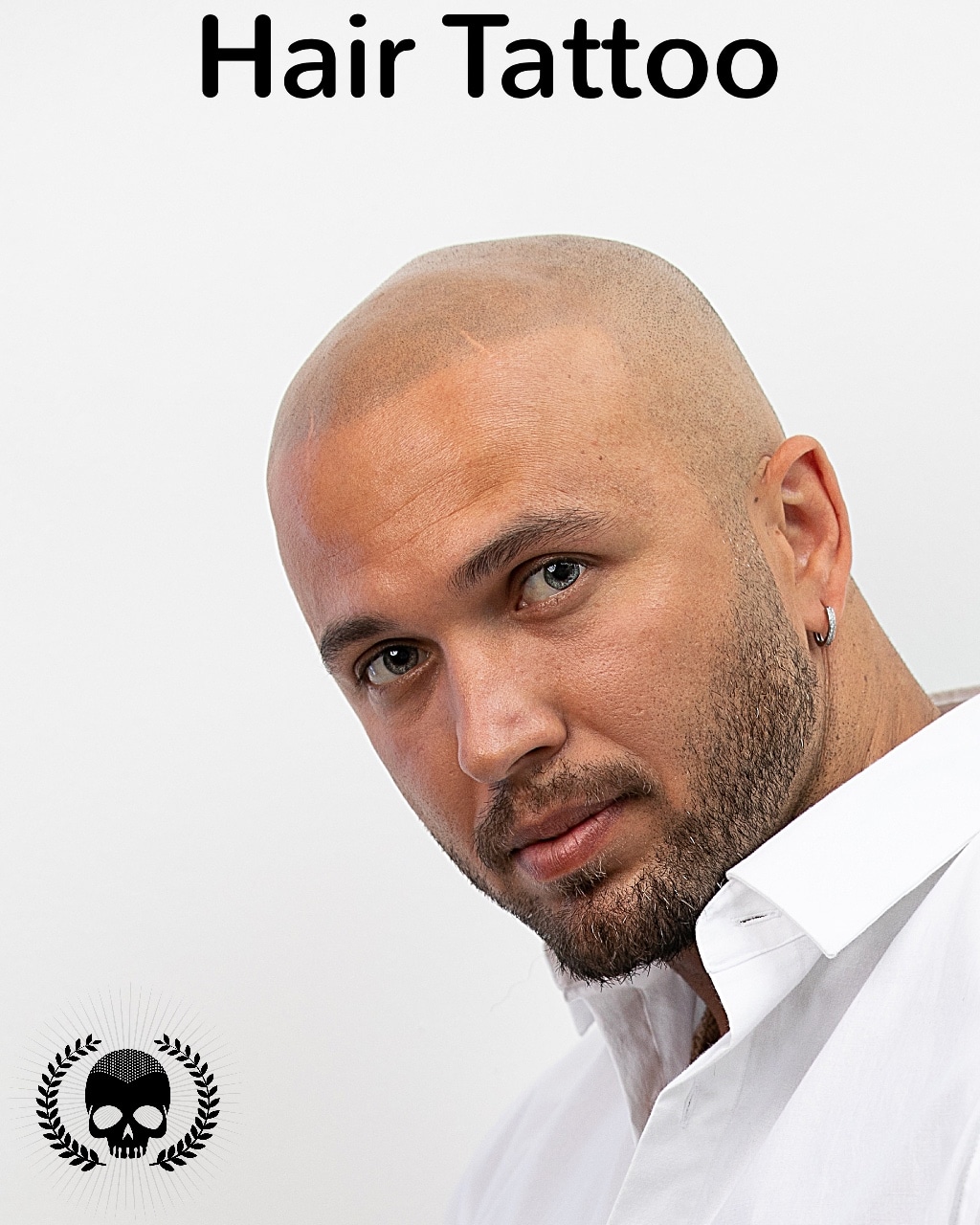
Scalp micropigmentation
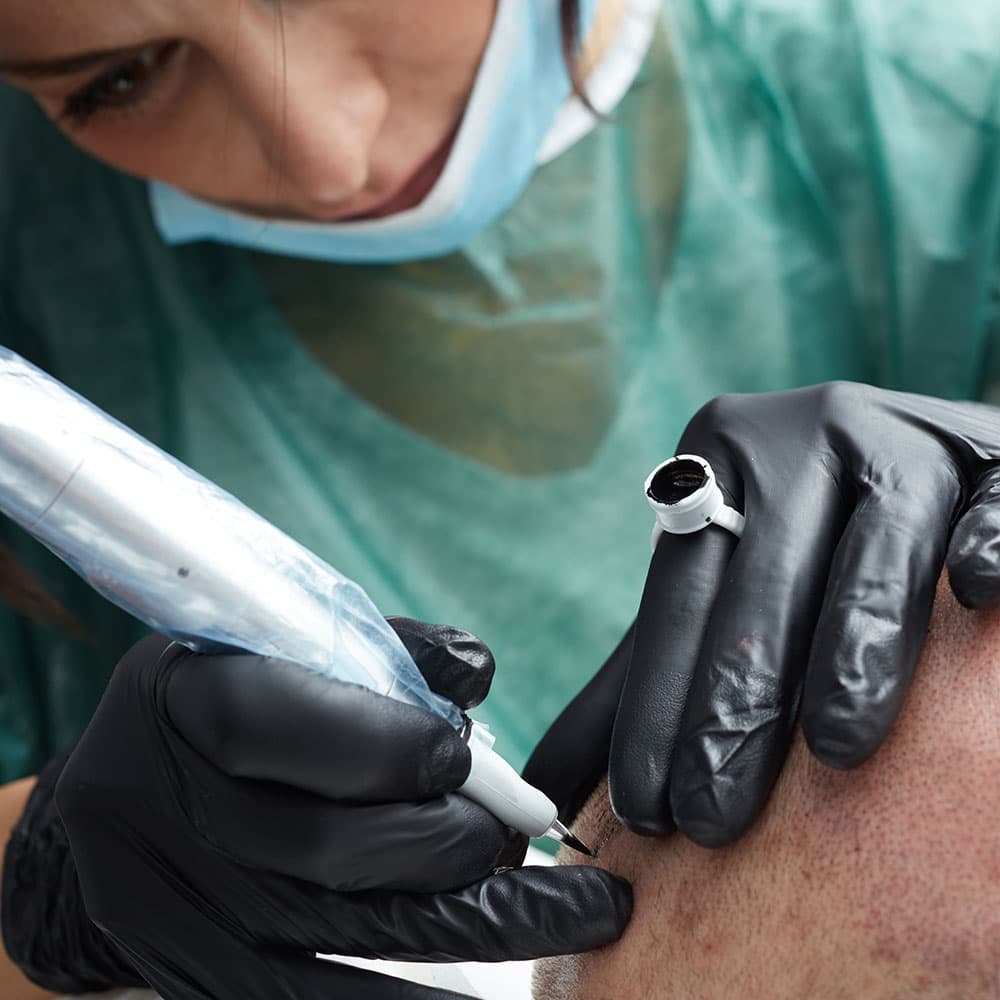
SMP, also known as scalp micropigmentation, is a non-invasive, non-surgical procedure in which pigment is surgically inserted into the scalp to mimic hair follicles, giving the appearance of a full head of trimmed hair that perfectly complements your natural skin tone and hair colour. Although the two procedures are comparable, scalp micropigmentation is not the same as a scalp tattoo, despite popular belief. The type of ink used in tattooing and scalp micropigmentation is one of the key distinctions.
Although carbon is the major component, most inks used for scalp micropigmentation are created from natural materials. In contrast to tattoo ink, which has a metal basis and is composed of a range of colours to create the colour, including black, which is composed of bluey/green tones, the pigment is entirely black. Many people mistakenly believe that because the pigment in scalp micropigmentation is black and they have light-colored hair, they cannot get it done. This is not the case.
To make lighter-shaded pigment, any scalp micropigmentation pigment can be diluted. A dilution scale should be used to get the right measurements so that the dilution to pigment ratio is correct. Before implanting pigment into the skin, the following processes are taken:
To choose the right colour to fit the client and the right ratio, see the dilution chart.
Fill a treatment cup with the water content after measuring it. The amount of water in millimetres that is being measured must match the scale’s selected colour.
The pigment should be measured and added to the distilled water. No more than 1 millilitre of pigment should be used.
Last but not least, stir it.
If little to no water is applied, the pigment will be virtually entirely black; this is best for clients with dark complexion and hair because less water helps to preserve the colour of the pigment. Anyone with light complexion and blonde or light brown hair should use this pigment if a lot of water is added to it, preferably 20 millilitres and higher, give or take. Any clients with medium-toned complexion and medium-colored hair should drink the amounts of water in between.
In order to prevent the treatment from looking excessively dark after several sessions, the artist will typically use a light shade during the initial session. Depending on their preferences, the patient may elect to have the pigment slightly darker, although doing so will need them to wet shave frequently to prevent a colour contrast between their natural hair and their scalp micropigmentation treatment. Therefore, scalp micropigmentation can guarantee natural-looking results for those who are experiencing hair loss, regardless of the skin or hair colour. But keep in mind that there are clinics offering training in pigments, including Skulltec Southwest, here for your training needs.
[button text=”Click me! I want to learn more” expand=”true” link=”https://skulltec-southwest.co.uk/training/”]
-
The Top Aftercare Advice For Scalp Micropigmentation
Before you can enjoy the results of your scalp pigmentation treatment, it is crucial that you follow the right aftercare instructions. Failure to do so may reduce the impact of your SMP treatment and potentially endanger your health.
[ux_image id=”844″]
[gap height=”60px”]
The procedure for getting a tattoo and scalp micropigmentation are very similar. In essence, you are having a tattoo on your scalp, but in this case, the goal and result are different.
Aftercare for scalp micropigmentation
After the procedure is over, fresh skin will develop over the top layer, which is what gives the result the most realistic appearance imaginable.After the procedure is through, life will pause for a short while by the side of the road before returning to its normal course. Over the next few days, you must avoid doing this.
- touching your scalp (unless in an emergency)
- wearing a hat, cap, helmet, or any other type of headgear that could cause your scalp to get irritated and rub
- letting any sunlight on your head
- excessive perspiration, especially after activity
- shampooing your head
- shaving the head
- Swimming
Your scalp will have started to mend and acclimate to its new pigmentation after this initial period of a few days. To ensure optimal aftercare for your scalp micropigmentation operation, there are still some procedures you must take. Following your treatment, over the following two weeks, you should:
- every day, merely use water to wash your scalp;
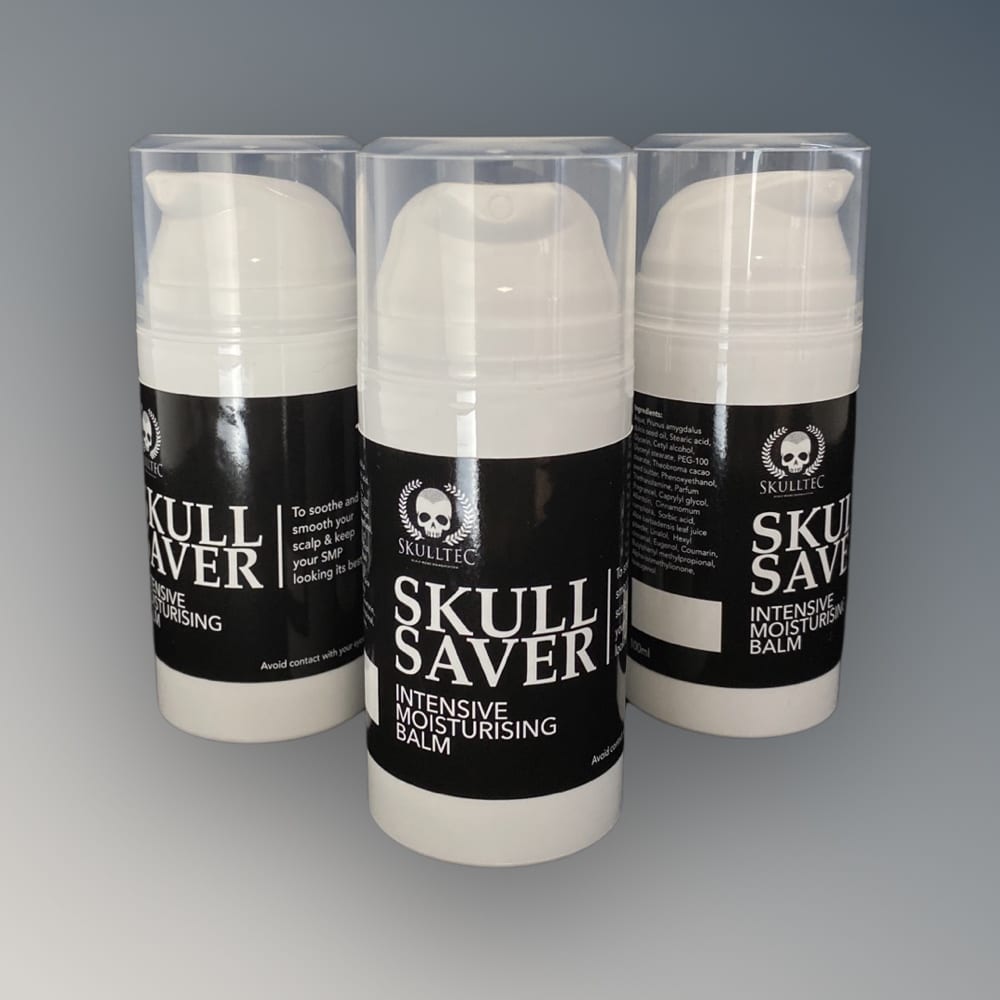
- Use an alcohol-free moisturiser on your scalp every day (Skulltec Product Recommended);
- Gently and carefully shave your head, taking care not to be harsh;
- When you swim, use a swimming cap;
- Try not to sweating too much.
- Avoid picking, scratching, or itching your scalp.
- Following a fortnight, you should: Daily wash and moisturise your scalp;
- Be careful when shaving your head; use sunscreen with a minimum SPF of 30 whenever you are in direct sunlight.The pigmentation of your treatment will appear darker right away as it is finished. One week following your last session, the actual and final colour will show. While the pigmentation may initially appear paler while the skin heals, you should under no circumstances pursue additional micropigmentation operations during the four weeks following the conclusion of your treatment.
from the tenth day onward.
The 10th day typically signifies that you have recovered enough to resume your regular routine, depending on how rapidly you recover from injuries. Your next appointment time will be set based on how quickly your healing has advanced thus far.Similar to the prior appointment, the practitioner will advise you to have a haircut and give your head a good wash, this time with shampoo or another product that is suitable for your skin. You should be aware that overexposure to the sun may cause your scalp to itch. Additionally, after the first session, the scalp tattoo will have slightly faded, so don’t be concerned by this. This is very standard fare.
[button text=”BUY OUR PRODUCT” radius=”10″ expand=”true” link=”https://skulltec-southwest.co.uk/shop/”]
[gap height=”60px”]
[button text=”Click here to book your consultation” radius=”10″ expand=”true” link=”https://skulltec-southwest.co.uk/contact/devon/”]
-
What is the recovery time for SMP?
Everything you need to know about the healing process for scalp micropigmentation.
A relatively recent procedure called scalp micropigmentation has been developed to cure alopecias and hair transplant abnormalities in men and women of all ethnic backgrounds. In contrast to hair transplantation, the treatment is non-surgical.
[ux_image id=”308″]
[divider width=”60px”]
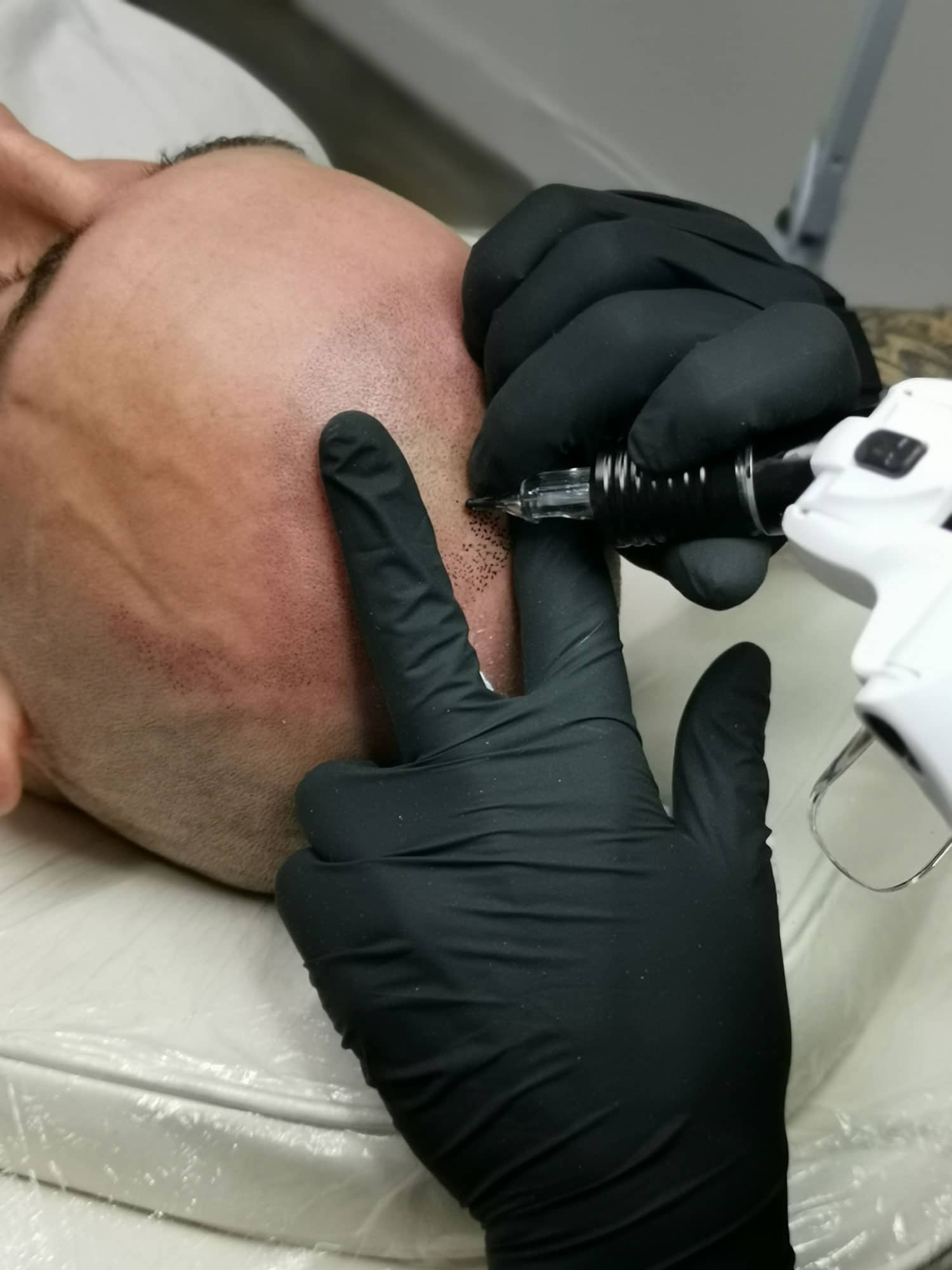
SMP, hair pigmentation, and hair tattoo are some of the numerous terms for scalp micropigmentation. Despite what it is named, it is not a typical tattoo on the skin. Instead of employing the scraping technique (conventional tattooing), a qualified SMP Artist injects pigments using a dotting technique under the skin during the Scalp Micropigmentation procedure. The goal is to make all hair and scalp imperfections barely perceptible while creating the appearance of a scalp with higher hair volume.
The operation is harmless in and of itself, but because it punctures the skin, the immune system starts the healing process after scalp micropigmentation. It’s not as terrifying as it may sound.
How to execute scalp micropigmentation
An initial consultation occurs before the Scalp Micropigmentation Procedure. The customer and a scalp micropigmentation artist talk about reasonable expectations during this visit. Various cosmetic aspects, such as the existence of blemishes or scars on the scalp, skin colour, hair colour, and the quantity of hair present, influence the requirements, which change depending on these circumstances. Making a hairline and choosing the pigment colours are the first steps in the treatment. A certified SMP Technician puts a microdroplet of pigment through the epidermis and into the higher dermis during the initial scalp micropigmentation session. To reach the top dermis, the needle punctures the skin’s epidermal layer. Every scalp has a particular supporting structure and thickness. The SMP Artist’s training and experience determine the appropriate amount of pigment to apply. To get the desired result, it is important to modify the depth of needle entry because every scalp creates varied skin turgor.
Healing of scalp micropigmentation
The procedure for scalp micropigmentation is regarded as a damage to the skin, and understanding of the fundamentals Understanding the basics of the Scalp Micropigmentation Healing Process is essential.
Wound Meaning A wound is any place where the skin is disrupted. Disruption of typical anatomical structures and function is how it has been described.Healing Wounds Scalp Micropigmentation (SMP)
Results in a negligible tissue loss, and as a result, healing is categorised as Healing by Primary Intention. Our body immediately sets out to restore the integrity and barrier function of the skin. There are four stages to the healing process, and epidermal continuity is often restored within 24 to 48 hours. Within a month, the incision is covered by an intact epidermis and cellular connective tissue that is free of inflammation.
Process for Recovering Scalp Micropigmentation
The redness and potential swelling and tenderness of the skin emerge immediately after the pigment injection into the scalp. The body naturally starts the healing process for scalp micropigmentation. It’s natural for the skin to initially react to the therapy with redness. On lighter skin tones, it often goes away after about 24 to 48 hours. Darker skin tones are less prone to become quite red. From day 7 to day 13, the ink particles often gather in a more concentrated area in the upper dermis.
The skilled Scalp Micropigmentation Technician must balance what is visible at the surface during the initial session with the anticipated loss of some of the more superficial epidermal pigments within a few days. Scabs begin to form the first week after the redness goes away.
You must never attempt to scratch or remove the scabs on your own. These must naturally mend and shed their skin. There is a chance that the Scalp Micropigmentation would look uneven if you pierce the blisters. After about a week, the scabs start to come off, removing a considerable amount of pigment and producing a lightening effect. Smaller, lighter specks will continue to exist. The result obtained right after the initial SMP treatment session changes as the pigment settles and fades during the scalp micropigmentation healing process. Because some scabs heal more quickly than others, the results of scalp micropigmentation can appear uneven. There is no cause for concern.
The secret is to be patient. More ink will be injected into the scalp to improve density and create the appropriate hairline because the entire operation requires several sessions. Scalp Micropigmentation Healing Process varies from person to person because everyone is unique. Everything is dependent on the health, lifestyle, and scalp condition. It is crucial to speed up this process because the body must mend the skin on its own. The body will have an easier time healing the skin if it gets enough sleep since it will have more energy. In average, it shouldn’t take more than four weeks to see the final results of a Scalp Micropigmentation process.
[button text=”Click Here To Book a Consoltation” radius=”10″ expand=”true” link=”https://skulltec-southwest.co.uk/contact/devon/”]
-
How Scalp Micropigmentation looks great on men of different ethnicities?
Everything you need to know about darker skin scalp micropigmentation.
Men of all ages are susceptible to the dermatological disorder known as alopecia (hair loss). Men lose hair and develop pattern baldness in a variety of ways and to varying degrees, regardless of their ethnicity. Sadly, that is the reality. Even while the hair loss issue is not life-threatening, its emotional toll always has an adverse effect on a person’s quality of life, adversely affecting the psychological well-being of affected males of all races. Why is obvious. The most noticeable aspect of the appearance is the hair. Therefore, those who experience hair loss must overcome its psychological effects and look for a workable cure. Thanks to Scalp Micropigmentation, hair loss conditions can now be successfully concealed.
[ux_image id=”853″]
Ethnic Hair Types
According to ethnic origins, researchers typically divide hair into three broad categories. Different hair characteristics are present in each ethnic group.
Chinese Hair Asian women typically have straight, black, and thick hair. This ethnic hair type has a variety of distinctive shapes and qualities. typically has the fastest growth rate (411+/-53 m/day) and the strongest mechanical characteristics.
African Hair African hair grows more slowly and is more brittle, which results in less stress during breakage and less fibre lengthening during breakage. is typically distinguished by tightly curled hair that grows nearly parallel to the scalp.
European Hair The appearance of Caucasian hair is straight, curly, or wavy. might range from blonde to dark brown in colour. has the most hydrated fibre and grows diagonally at a medium rate (367+/- 56 m/day).
Sadly, hair thinning and loss issues affect all of the aforementioned ethnic groups. Different ethnic groups experience hair loss in a variety of ways depending on the severity of the scalp’s decreasing coverage.
Dark skin, scalp micropigmentation
Everyone thinking about Scalp Micropigmentation anticipates non-artificial results that flawlessly complement their natural skin tone and hair colour. Anyone can undergo the operation, but the most important thing is how the treatment turns out in the end.
The process of scalp micropigmentation on a client with dark skin is difficult and increases the level of complexity of the treatment. It necessitates a thorough comprehension of the variations in hair morphologies, structures, and characteristics among different groups. A certain set of skills, knowledge, and experience are necessary to properly conduct scalp micropigmentation on dark skin.
How come?
When applied to dark skin, scalp micropigmentation requires the proper density and application technique.
Men of African and Asian descent need a different blending and follicle reproduction technique because their hair is fuller and thicker than that of Caucasians. In order to fill larger hair follicles, more ink is required. Additionally different, with more defined, sharp modern features, are their hairlines and hairstyles.
What are the dangers?
The final appearance might not be as seamless as it should be if the technician performing the Scalp Micropigmentation on dark skin is inexperienced and the follicles are the wrong size. While there are no health risks associated with scalp micropigmentation on dark skin, it is important to maintain the definition of each individual dot. When treating darker scalp, the warning must be taken seriously to prevent a blackout effect (merged pigment spots).
How do you reduce the risk?
Take a hint from those who apply scalp micropigmentation to people with dark complexion to prevent the results from being ruined and to avoid leaving a smear on your scalp. Choose a trained scalp micropigmentation artist who has experience specifically treating dark skin tones with this procedure. Look over each clinic’s portfolio, read the reviews, and request examples of photos. Before you even schedule the first visit, this is really important.
Be wary if the SMP artist claims that SMP on males with dark skin is similar to SMP on men of white Caucasian background. It is the first indication that this specific SMP artist is unaware of the demands for darker skin tones. Please take all precaution to avoid this one.
[ux_image id=”765″]
Click here to learn more about how to select the best scalp micropigmentation artist for your procedure.
Dark skin tones can benefit from scalp micropigmentation in the same way as male clients of any other ethnicity do. The secret lies in selecting a Scalp Micropigmentation Clinic with experience working with men of colour. At Scalp, we recognise that while all men who are experiencing hair loss have similar issues, darker scalps have particular needs. Without a doubt, Scalp can meet these needs.
Our office is only a phone call away if you’re looking for the best Scalp Micropigmentation Clinic to treat dark skin. Contact us right away.
[button text=”Book Your Consultation Now” radius=”10″ expand=”true” link=”https://skulltec-southwest.co.uk/contact/devon/”]
-
Does the SMP Treatment work with Grey Hair?
What effects does the SMP Treatment have on grey hair?
You’ve come to the right place if you’re wondering how scalp micropigmentation and grey hair can complement one another. We will go over how Scalp Micropigmentation can benefit people with grey hair below.
[ux_image id=”889″]
What effects does the SMP Treatment have on grey hair?
Grey hair and scalp micropigmentation.
According to study by Mintel Press Office (Market Research Company), males in Britain are most concerned about their hair colour when it comes to appearance. The age at which panic begins to set in is 45. Hair thinning and loss take second place. [1] In general, men are more inclined than women to accept their appearance, however after the age of 45, the aforementioned features of men’s appearance make them less content.
The study’s findings make it crystal clear what the real problems are with men’s hair. Men start looking for an effective therapy when their hair starts to lose its natural pigment and becomes progressively thinner. It develops into a problem that can impact confidence and self-esteem in addition to beauty. Scalp Micropigmentation, commonly known as SMP or hair/scalp tattoo, is one of the most efficient non-surgical treatments.
One of the most well-liked non-surgical solutions to the problem of greying, balding, or thinning hair is scalp micropigmentation.
How does the SMP Treatment aid in problem control?
Scalp micropigmentation is a technique that imitates hair follicles to give the look of actual, natural hair. No matter what colour your hair is, SMP allows you to always produce a hairline that appears extremely natural.
There are two possibilities when it comes to scalp micropigmentation and grey hair.
1. Prior to the first Scalp Micropigmentation Treatment, you already had some grey hair.
A Scalp Micropigmentation procedure typically involves a consultation and two to four sessions altogether. Initial consultations are quite important because several things must be established at those meetings. Color matching is one of them. In order to determine which pigment options are most appropriate for the treatment, your chosen Scalp Micropigmentation Technician will compare the colour of your existing hair follicles to those offered by the pigment manufacturers. Pigments are always chosen to meet specific requirements. Scalp Micropigmentation Artis will match the pigment’s tone and hue to how grey your hair is. Please go here to read more about what to anticipate during the Scalp Micropigmentation Procedure.
Please remember that most guys will seem clean and natural if they continue to keep a shaved appearance after having scalp micropigmentation. Always, the hair’s base is darker than the hair itself. A generalisation is that short hair will look darker than long hair.
If you have grey hair on your sides and are bald on top, you might be pleasantly surprised to learn that grey hair can be blended into your sides with Scalp Micropigmentation and yet seem natural and genuine.
2. Following the Scalp Micripigmentation Treatment, you have begun to grey.
Regarding Scalp Micropigmentation and the onset of grey hair following the SMP Procedure, there is not much to worry about. You can still fully benefit from the SMP Treatment even if your hair occurs to start greying after you receive the SMP treatment.
Each Scalp Over numerous years, micropigmentation progressively disappears on its own. There is no way to stop long-term fading, which is brought on by a number of distinct circumstances. When the pigments will start to fade is difficult to predict. The outcomes may vary from person to person because each person has a unique scalp and lifestyle. Please click here to read our dedicated blog article to learn when the first top-up is typically needed.
Greying follows a similar rule. It is a steady procedure that doesn’t take days to complete. After your original Scalp Micropigmentation Procedure, if you start to get grey hairs, you might be able to forgo the touch-up procedures that are necessary every few years to keep your Scalp Micropigmentation looking good. Grey hair frequently enhances attractiveness by adding to overall appearance and making Scalp Micropigmentation Treatment more realistic. Based on our experience, we can attest that the first established blend continues to appear natural over time and that fading pigments complement greying hair remarkably well.
There is another option if grey hair that appears after the Procedure and scalp micropigmentation worry you. You can apply a lighter hue that complements your new appearance during the touch-up procedure.
[ux_image id=”943″]
In actuality, grey hair and scalp micropigmentation are not problems. As you can see, the SMP Treatment is made to be effective on hair of any colour, even grey. Get in touch with Scalp, the top Scalp Micropigmentation Clinic in, if you live in Exeter or the nearby areas and are seeking Scalp Micropigmentation for your grey or thinning hair. In order to produce the most realistic results, we are fully capable of adjusting our pigment selection to match the tone of your grey hair.
Please feel free to contact our award-winning Scalp Micropigmentation Quinton Gordon, who is always delighted to support anyone on the road to hair loss treatment, if you have any additional concerns about this procedure and grey hair.
[button text=”Book Now” radius=”10″ expand=”true” link=”https://skulltec-southwest.co.uk/contact/devon/”]
-

Alopecia Universalis
The most severe type of alopecia universalis. According to general guidelines, this ailment typically begins as alopecia areata (patchy hair loss on the head), which in rare instances can develop to alopecia totalis, which manifests as the complete loss of all head hair, including eyebrows and eyelashes. Rarer still, this condition has the potential to develop to affect every hair on the body, at which time it is known as alopecia universalis.
This type of alopecia is very difficult to treat. While corticosteroid injections can occasionally be used to treat areata, the affected region with universalis is simply too large for this to be a practical treatment. The severity of this ailment also makes it unlikely that hair will regrow, and even if it does, the likelihood of the symptoms reappearing later is substantially higher. Unfortunately, the majority of sufferers must learn to live with this because, despite some treatments having some chance of working, there is no cure for this condition.
WHAT BENEFITS CAN SCALP MICROPIGMENTATION BRING?
Although SMP is not a treatment for alopecia, it can be a very good disguise. Scalp micropigmentation is becoming more and more popular, especially among individuals who are likely to experience long-term effects, as a technique to relieve the symptoms and lessen unwanted looks and comments that can have a terrible effect on confidence and self-esteem.
It is presently not possible to use this option to restore the appearance of eyebrows and eyelashes, but it does offer a very strong, long-lasting illusion of having a full head of hair and can even be used to mimic beard hair.
-
How to get a career started in scalp micropigmentation (SMP)
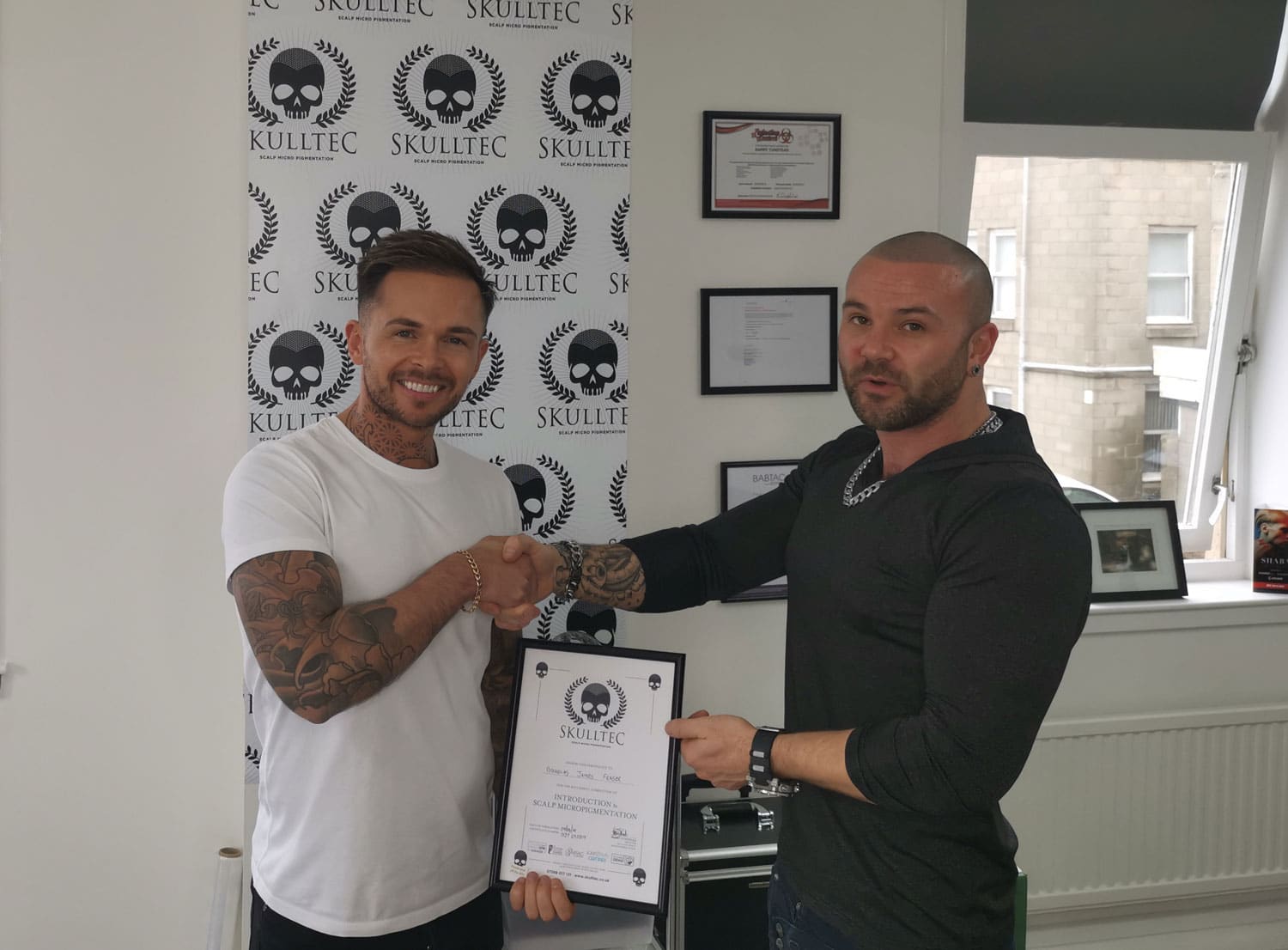
Here at Skulltec, we specialise in offering scalp micropigmentation, with hair loss clinics in Paisley, Glasgow, Ayrshire, Doncaster and Exeter. We are the largest SMP (scalp micropigmentation) specialist in the whole of Scotland, offering clients every kind of hair loss solution from scar camouflage to density treatment. In addition to offering these services to our customers, we also provide SMP training courses to those who learn from the best, with Skulltec having been voted the best hair loss clinic in Scotland by the Scottish Hair and Beauty Awards in 2019, and awarded with the prestige of the Innovation and Technology award at The Look Awards, hosted by The Herald in 2018. If you’re interested in discovering more about our micropigmentation courses, read on to find out about SMP training at Skulltec, the design of the course, the course content and everything else that is included.
Our SMP Training Course
If would like to receive training offering your clients scalp micropigmentation in the UK, at Skulltec, we provide you with training courses using the most advanced equipment, making sure to follow the ethical code and professionalism practice standard of the British Association of Beauty Therapy & Cosmetology (BABTAC). Deemed the best hair loss treatment, scalp micropigmentation is suitable for both men and women. Your SMP training will be delivered by our technician, Barry Tunstead. Upon completion of your SMP training, you will able to treat clients suffering from male or female pattern baldness, alopecia and scarring with micropigmentation.
The Design of the Course
The scalp micropigmentation training course is taken across three days. As we offer our SMP training courses one-to-one, rather than in big groups, we can tailor our course to your needs. This means that we will consider your experience thus far, plus any pre-existing industry knowledge you may have. Once you have finished the course, you will obtain a qualification in scalp micropigmentation. It is also necessary for you get licencing credentials from your district council, which we can help and advise you about. As part of the course, we include First Aid training and infection control. You will receive the corresponding certification and will be on your way to having full UK indemnity cover.
The Content of the Course
First and foremost, our SMP course content includes all aspects of health and safety, covering how to prepare the scalp for the treatment to ensure a hygienic and safe environment to carry out the treatment. We also go over different techniques for scar camouflaging, density treatment techniques, and advanced hairline design for achieving feathered and gradient effects, so whatever you clients opt for, you will be able to provide them with the best service possible. To perfect your techniques, you will learn about hand pressure, and the skills for blending, spacing and depth, looking at the different needles and pigments, as well as how to master permanent impressions, to finish a client’s course of treatment within two to three sessions. Furthermore, will cover subjects such as insurance and bylaws, and consent and aftercare guidelines and paperwork. Additionally, we will cover how to hold consultations with clients and how to market your SMP service as part of your business.
What is Also Included in the Course
As well as everything listed above, our scalp pigmentation courses at Skull also include all the necessary equipment you will be learning how to use and apply to future clients. These items include the rotary pen machine, an iPower watch, needles, pigment and all other accessories. You will also have the benefit of working on a live model, so you can feel confident applying SMP in the real world.
Contact Us
For more information about our SMP training, please get in touch with us through our online contact form, or by emailing us at info@skulltec-southwest.co.uk. Alternatively, you can also speak to a member of our team about our scalp micropigmentation training courses by calling us on 07388 017 121. Based in Paisley in Scotland, we are pleased to provide training to those who would like to offer scalp micropigmentation to clients in the UK. We will be happy to answer any questions you may have for us.
-
The importance of following proper aftercare in the weeks after your treatment.
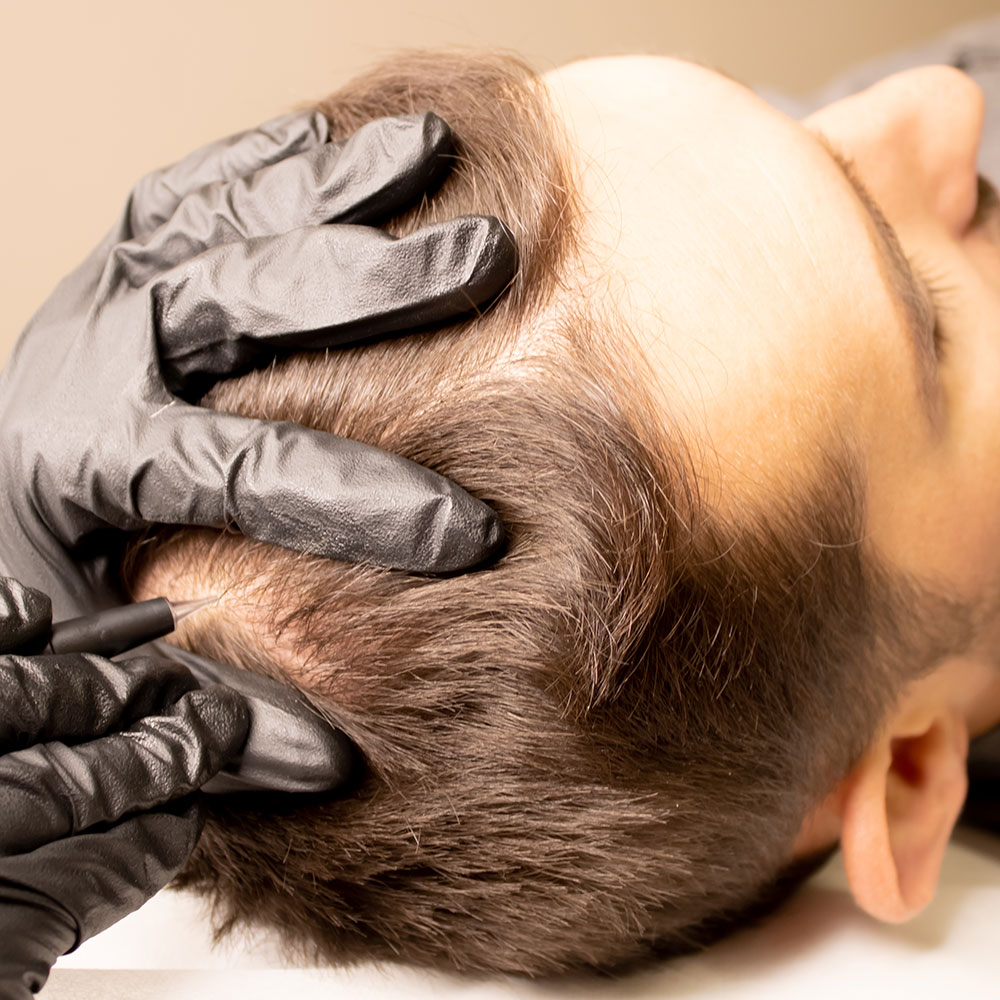
When preparing to have scalp micropigmentation treatment to combat balding or thinning hair, there is a lot of dedicated time and energy involved in the process. From researching whether the treatment is the right choice for you, to booking in the appointments to have the pigmentation sessions done, many feel a sense of relief and content once the process is complete. What many don’t realise, however, is the importance of sticking to a proper scalp micropigmentation aftercare routine. Today, we will be taking a look at why following proper aftercare following scalp micropigmentation is so important, while covering some rules and tips to follow to get the best results.
Scalp micropigmentation aftercare: Why is it so important?
Failing to follow the proper aftercare measures can have several consequences, some more serious than others. It can delay the time it takes for your scalp to heal, potentially causing you discomfort for longer periods of time than necessary. It can also lessen the quality of the final results, causing the ink to lose colour pigmentation and intensity more quickly than usual. In worst cases, it can even cause irritation and pain to your scalp, which can carry potential health issues. By sticking to a good aftercare regime, however, you can easily avoid these risks.
How long do I need to follow scalp pigmentation aftercare for?
We recommend following aftercare in several stages. The first stage refers to the days in the immediate aftermath of your treatment. The second stage encompasses the next two weeks after this initial period, followed by general steps you should follow after this fortnight period in order to obtain optimal results.
What do the steps involve?
For a clear breakdown of our suggested aftercare steps, take a look at our aftercare page on our website. This explains in detail what you should follow and when, in order to encourage a healthy healing process of your scalp micropigmentation treatment.
In general, however, for the first few days you should avoid touching your scalp, except where extremely necessary. You should also avoid exposing it to sunlight and chlorinated water, as well as washing it. Excessive exercise should be avoided, as this can cause sweating, which can irritate and delay the healing process. Moving forward, even after the first few days and weeks have been taken care of, you should still be using an SPF when in strong sunlight and should take care when washing and shaving your scalp. These can all help you to keep your new scalp pigment treatment looking its best. For a complete step by step of the aftercare process, as mentioned previously, refer to our aftercare page.
Get in touch
Should you have any remaining questions on our scalp micropigmentation after care, please do not hesitate to contact us. We will be happy to provide you with any further information you need to establish your aftercare routine. You can send us an email at info@skulltec-southwest.co.uk, or if you prefer to speak with someone directly, you can give us a call on 07388 017 121.
-
Not 1, Not 2, But 5 Hair Transplants

We’ve done a case study on our model so we can help encourage you to consider Scalp Micro Pigmentation as an option when considering a hair transplant. A hair transplant is expensive, it’s also a big decision, it will have a huge impact on your appearance, and change your life forever, especially your confidence and well-being. I’ve personally had the SMP treatment so I’m talking from experience.
Our model here has spent over £20k and endured all the pain over the years from his 5 hair transplants, all 5 have failed and he ended up getting SMP, £20k down the drain. SMP and hair transplants are very different procedures in terms of treatments and results. On the one hand a hair transplant will replace your lost hair, and SMP will give you the illusion of shaved head or increased density.
In this particular case, our model has had 4 FUT (follicular unit transplantation) and 1 FUE (follicular unit extraction) hair transplants. In summery, an FUT transplant is where they cut a strip from the donor area (back of the head), the hair follicles from the strip are diced into tiny blocks and replanted in the area being treated for hair loss. An FUE transplant is where they extract individual hairs and replant them in the balding area.
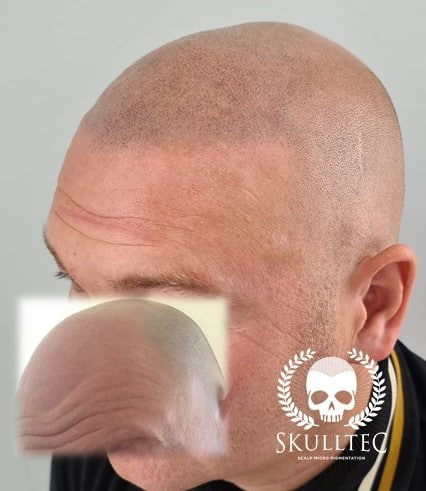
If you look at the image below closely, you can see the FUT scar across the back of his head, its roughly 15 centimetres in length, and averages around 4 millimetres width. There is also scarring above and below the strip, this is the result following his FUE hair transplant, leaving numerous tiny bald patches everywhere.

Following the 5th hair transplant our model was advised to stop taking medication that was prescribed after his 4th hair transplant, he was taking finasteride, a drug to help stun or stop male pattern baldness. Coming off the medication he started losing his hair again from all previous procedures, the last hair transplant grew very different to the other hair transplants. If you look at the image below you can see the hair nearest his hairline is much thicker and slightly darker in colour.

I’ve noticed this with most of our clients who come into our clinic after failed hair transplants, the texture of the hair is straw like, much thicker than normal hair, and in most cases the hair is slightly different in colour. But this is the least of your worries, the aftermath is the part that personally haunts me, and the part I feel is most overlooked as everyone’s thoughts are consumed and focused on the end results.
It’s not just the brutality of the procedure, the cost, the scars, and/or the risk of it failing, but the aftercare using shampoos, medicines, cleansing, bandaging, cost of aftercare medication, side effects etc. He also mentioned the FUE hair transplant is way more painfil than the FUT hair transplant. More people are documenting the progress pre/post surgery, I’d advise watching as many videos as you can, both successful and failed hair transplants.
I read a recent study that surgeons now want use chest hair for hair transplants. This would open up a whole new market for people who don’t have the right grade of hair for the procedure, I’m yet to see results, but I can only assume it would look like pubic hair on your head, I personally would never consider this an option.
The SMP procedure our model decided to get is called density treatment, we have created the illusion of a full head of hair, and camouflaged the scarring as seen in the before and after images below.

Scalp Micro Pigmentation normally consists of 3 treatment sessions 1 week apart. These images were taken right after his 3rd treatment, SMP really is an instant solution for receding hairline, baldness, thinning hair, alopecia and scar camouflage. The treatments looks best with shaven hair, but in a lot of cases we can help with the density to give your hair a fuller look. The procedure is non-invasive, literally pain free and the results are instant. I would urge anyone considering a hair transplant to at least look into scalp micro pigmentation, it may not be for everyone, but in this case, our model would have been £20k up, and not left with the scarring physically and mentally from 5 failed hair transplants.
-
Apparently Self Care (Bit of a Pamper) Helps Depression, I Agree, Now
I completely let myself go during the worst of my depression; frankly I couldn’t have cared less about how I looked. My staple Maw outfit of Leggings and a vest top made me so incredibly comfortable I was having episodes where I wanted to rip my skin off because I’m summoned up the courage to dare to wear a pair of jeans. Slowly, but surely I’m making more on an effort to look after me too.
You see, I am by no means Miss UK and I’m more than aware I’ve creeped up a dress size. Picking something that would be the right thing for me to perk myself up was really hard. How could I pick something that would boost my self-confidence with minimal effort, when I couldn’t even stand to look at myself in the mirror. Eyebrows, Lips, Hair extensions all required effort and with two tiny terrorists that makes things difficult to even have 5 minutes to myself.
I started seeing a lot of posts on Facebook for Skulltec – I absolutely loved the before and after pictures. My passion for hair made me love this even more, guys getting their hairlines back to make them feel great. I was chuffed for them, being a big fan of a Baldy heid – cause a hairdresser will never take her work home with her – I thought the changes for these guys must be massive, the confidence the return of the hairline changes their whole face and I’d imagine it would have made them walk a whole lot taller with a belting grin.
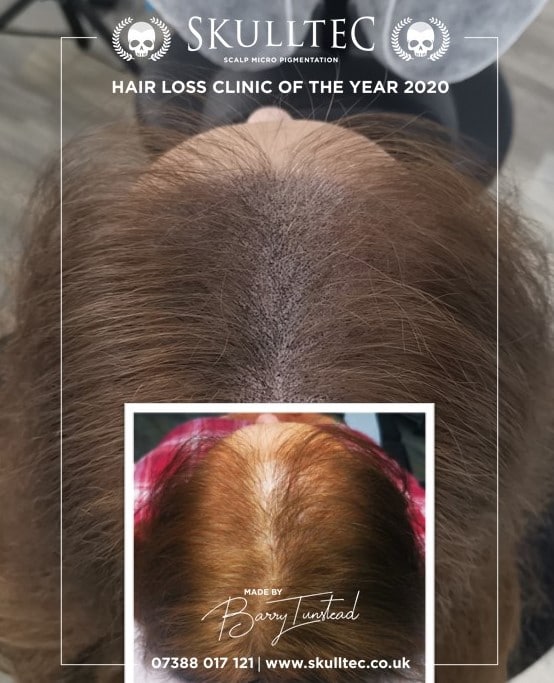
Then came the picture, a wee day out with the girls, photo bombed the picture caught red handed with a litre of RedBull and the Maw bun – there it was clear as day, the trauma of having two kids 14 months apart showed massively in the form of a big gaping hole not even remotely masked by the two new hair horns growing could cover it! PING!?! The light bulb came on and I knew what I wanted to do. Granted I was mortified, and I didn’t contact the page directly, I contacted the Queen of Hair about her Husband’s business and she reassured me he’d look after me. Barry gave me a quick bell and the consultation was set.
The consultation was quick and easy and we’d clicked on the same page I felt reassured I was with a real professional. However I will say which is important Barry was kind and said politely that it wasn’t that bad, which made getting it done a million percent my decision and my choice. I was having it! Appointment made which took a bit to get my diary free and I was eager to get started. Appointment one was easier than I thought it would be, Barry and I was so busy talking that I hadn’t even noticed he’d started let alone said right that’s you have a look! I noticed immediately the difference in my hair! The only regret I had was not doing my colour before I started the process – bloody grey hair drove me nuts. I followed Barry’s Golden Rules and got set for session two. Session two was like a therapy session, maybe it’s cool that your talking whilst someone holds you head, or that the sensation of it getting done is like someone counting your hair follicles with a pencil, it’s not sore it’s soothing. Job done and Wow it was even more noticeable and I loved it – well apart from that cheeky grey hair!
I can’t tell you the difference in two weeks how much of an impact it made on my life. It completely perked me up knowing that I might look like a totally stressed out mum but not that much that you can see my scalp as the kids run circles around me. My hair no longer looked like it was all I had left in the world but it looked thick, scraping it back I felt amazing, like I had definition back in my face.
Session Three –Barry says would you like to go darker and I’m like mate get the sharpie out Lego Head me – obviously I’m joking but I just wanted more because I was so buzzing from the first two sessions and how it looked I wanted more! What a difference, I’ve had a cry about the difference its made, how I feel about looking in the mirror and not having my scalp wave back at me. I no longer look like I’ve fallen apart on the outside to the world, no more massive circles of here’s what happens when you have two kids close together. I looked and I was reminded of younger days, with more energy! It’s certainly boosted my confidence, God help the world ear ache all round as I’ll be banging on about how awesome this is for a long time!A massive thanks to Barry not only for the amazing job, being a genius and being one part of the MR and MRS hair duo. Thank you from the bottom of my heart for being a part of my recovery from depression and for giving me back some self-confidence to take the rest of the world on. Thank you.


